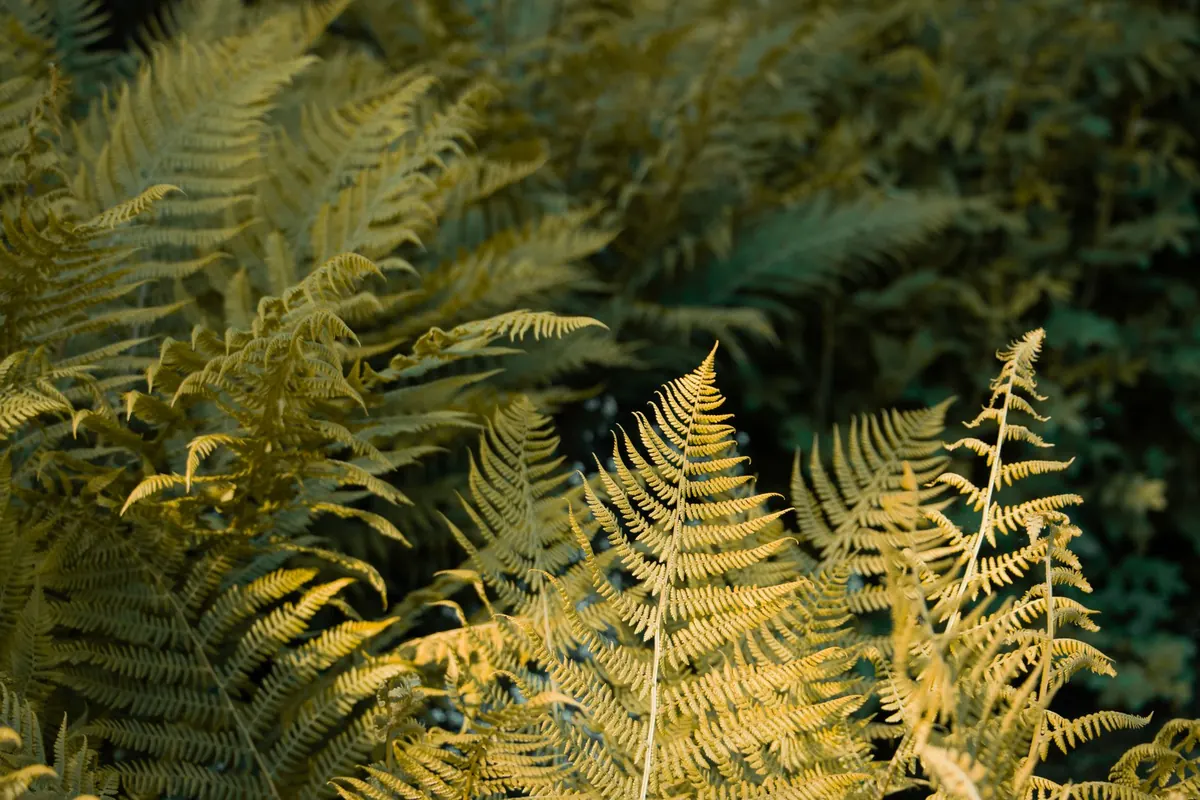
There is a strip of ground on the north side of most UK gardens that never quite dries out. The soil stays cool and crumbly into August, grass thins to nothing, and anything sold as a bedding plant gives up by July. Ferns, by contrast, settle in as though the spot had been made for them.
A shady border planted with ferns is not a compromise. Done well, it gives you unfurling croziers in spring, dense green texture through high summer, and evergreen fronds that hold the structure into winter while hellebores and snowdrops get on with the flowering. The trick is matching ferns to your particular kind of shade, then pairing them with plants that want the same conditions.
They are the quiet workhorses of the shade garden. No staking, no deadheading, no feeding, and their roots are shallow enough to slip between tree roots where little else will grow. What they contribute is texture: the lacy fronds of lady fern against the leathery straps of hart's tongue, or the tall, near-black stems of Dryopteris wallichiana rising above low ground cover.
They also give you a choice about winter. Evergreen and semi-evergreen types such as Polystichum setiferum and Asplenium scolopendrium keep their colour through the coldest months, while deciduous species like Matteuccia struthiopteris and Osmunda regalis vanish completely and return with real drama in spring. Mix the two and the border never looks bare.
Almost every fern wants the same thing: soil that stays moist but drains, with plenty of rotted organic matter worked through it. Think forest floor, not bog.
Deep, dry shade under conifers or a dense hedge is a different proposition, and fern choice narrows sharply. Hardy polypody (Polypodium vulgare) and broad buckler fern (Dryopteris dilatata) are the reliable options, and you should expect to water in dry spells.
Helleborus × hybridus with Polystichum setiferum. The hellebore flowers from January into March, and the evergreen fern conceals its collapsing foliage in summer. Cut the old hellebore leaves back in late winter to reduce leaf spot; the fern stops the gap from showing.
Galanthus nivalis naturalised in rough grass or beneath a deciduous shrub, with Dryopteris erythrosora. Its new fronds emerge copper-pink in spring, just as the snowdrops finish. Plant snowdrops "in the green" in spring rather than as dry bulbs in autumn; they establish far more reliably that way.
Hosta 'Halcyon' with Athyrium niponicum var. pictum. The fern's silver-pink fronds set off the hosta's glaucous leaves, and both want the same moist, humus-rich soil. Slugs are the only real work here: night patrols, a gravel mulch around the crowns, or nematode treatment in early summer all help, as does choosing thick-leaved hostas in the first place.
Asplenium scolopendrium with Helleborus foetidus. Both cope with drier, chalkier shade than most ferns and stay green all year. The upright strap fronds contrast well with the finely divided hellebore foliage and its clusters of green bells from December to March.
Matteuccia struthiopteris with Hosta 'Sum and Substance'. This is the pairing for the wettest corner of the garden. The shuttlecock spreads by runners, so give it room or sink a root barrier. When its fronds brown in midsummer, the hosta's large leaves take over the space.
Dryopteris wallichiana with Galanthus 'S. Arnott'. The dark stems and golden-green fronds make this fern a focal point rather than background planting. Snowdrops flower at its feet in February, well before the fronds unfurl above them.
Osmunda regalis with Helleborus × hybridus. For boggy ground beside a pond or a permanently wet patch. Royal fern is slow to establish but eventually makes a bold, almost shrub-like clump. The hellebores provide flowers while you wait.
Athyrium filix-femina 'Frizelliae' with Hosta 'Blue Mouse Ears', in a narrow border or a large pot. Both stay compact, which suits a small courtyard where every centimetre counts. Keep the pot in shade and water it regularly through summer.
The reason these pairings work is that each plant takes its turn. If you plan the border around that sequence rather than around a single season, it will earn its space all year.
Cut back deciduous ferns in late winter, just as the new croziers appear at the crown. Removing old fronds any earlier leaves the border looking ragged for weeks; leaving it any later risks snapping the new growth. Strip the old leaves from hellebores at the same time, and clear snowdrop foliage only once it has yellowed completely.
Divide congested clumps of Athyrium and Matteuccia Photo: Tobi &Chris / Pexels

Compact ferns for pots and narrow, shady courtyards, chosen for spring, summer, autumn and winter interest, with...

A step-by-step guide to collecting, sowing and raising ferns from spores in the UK, from the first green film to...
How to divide overcrowded ferns at the right time of year, with practical steps for lifting, splitting and...

Your guide to growing and identifying ferns.
